The convergence of physics, biology, and AI for unlocking life-changing medicines.
Partnered with Gero


Published in




Why we built this platform
Most longevity research targets the hallmarks of aging — senescence, inflammation, telomere loss. These can delay specific diseases. They have not, after billions of dollars, beaten what caloric restriction did for mice almost a century ago.
The reason is that aging isn't one process. Our work shows it's two: a reversible component of physiological noise that drives disease late in life, and an irreversible component of entropic damage that sets a hard ceiling on human lifespan at 120–150 years.
This separation, formalized in the Fedichev-Gruber theory, defines three classes of intervention:
- Level 1 — Hallmark drugs. Today's longevity field. Delay individual diseases. Small effect on aging itself.
- Level 2 — Noise-reducing drugs. A new class. Decouple disease from aging. Potentially 30–40 additional healthy years, reachable with current technology.
- Level 3 — Entropy-controlling drugs. Push the ceiling itself. The long horizon.
Our platform is built for Level 2 and Level 3 — where the rest of the field hasn't looked.
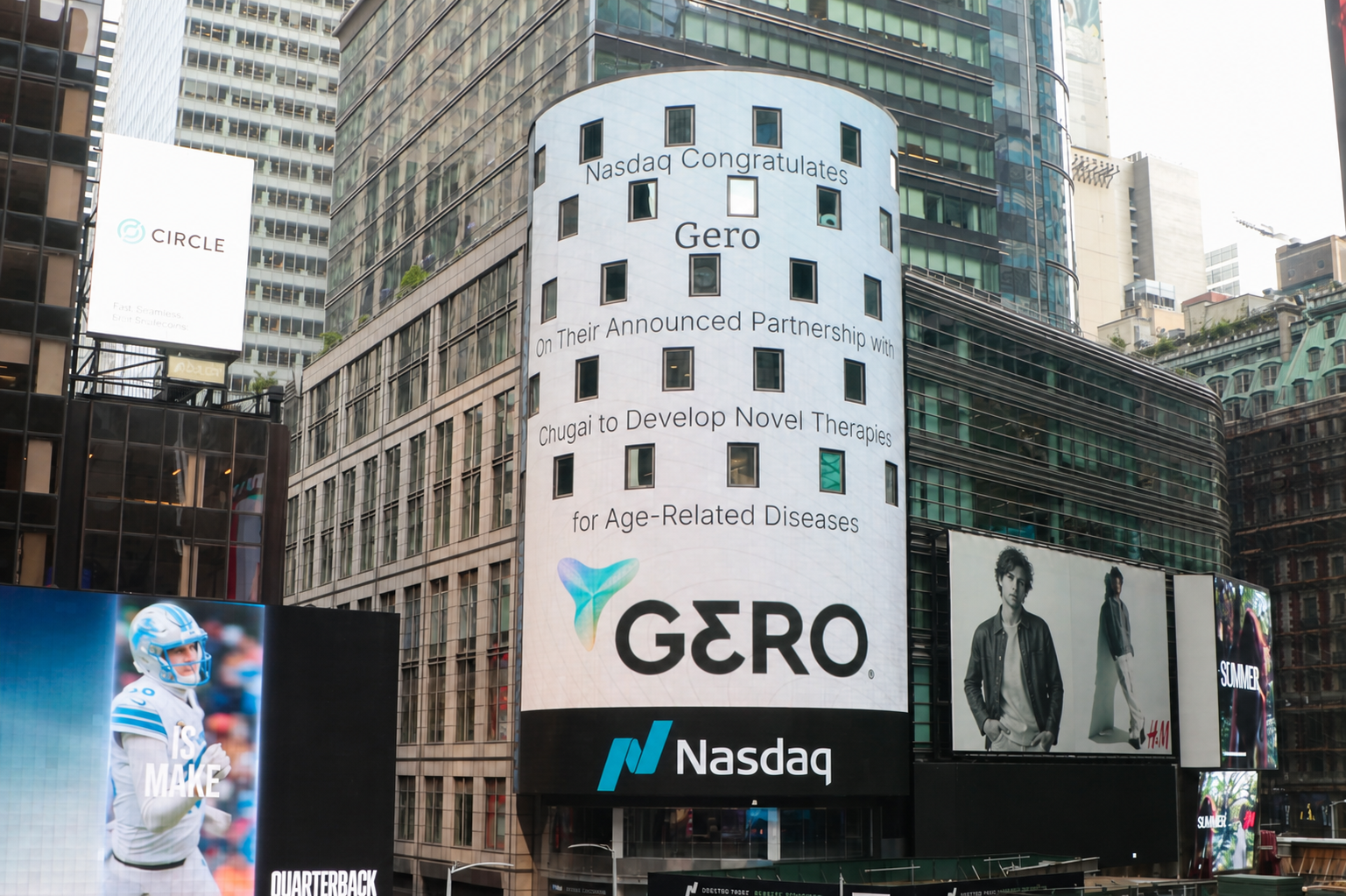
$250M co-development with Chugai Pharmaceutical
In July 2025, Gero entered a joint research and license agreement with Chugai — a member of the Roche Group — to discover antibody therapies for age-related diseases. The partnership applies Gero's Large Health Models to in-human target identification, with Chugai leading antibody development against selected targets.